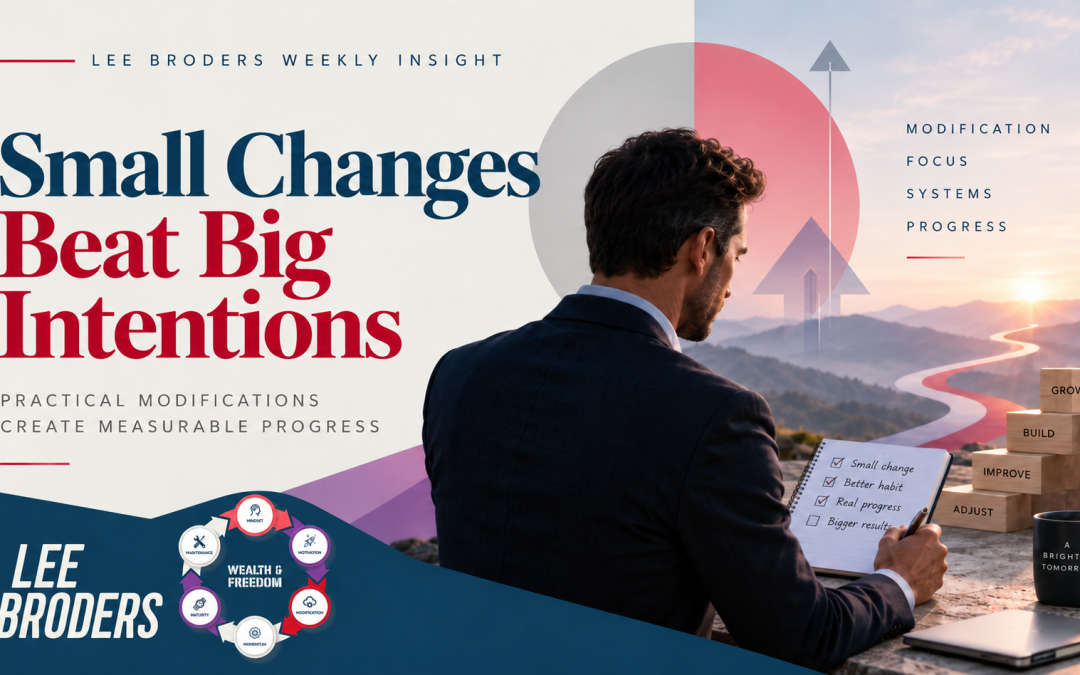
People often try to change too much at once. A new routine, new targets, new habits, new systems and a completely different way of working, all starting on Monday.
The ambition may be genuine, but the scale of the change makes it difficult to sustain.
Look for the smallest useful modification
When something is not working, the answer is not always a complete reinvention. Sometimes one practical modification changes the result.
That could mean changing how you structure your morning, how often you review your numbers, how you prepare for meetings, how you follow up leads or how quickly you make routine decisions.
Modification is about evidence, not novelty
Changing something because it is new is not the same as improving it. A useful modification starts with evidence that the current approach is not producing the result you need.
Before changing anything, ask what is actually happening. Where is the friction? Where is time being lost? What outcome is weaker than expected? What are people repeatedly working around?
The clearer the problem, the easier it is to make a focused change rather than create unnecessary disruption.
Change the environment, not just the intention
Willpower is useful, but environment usually wins. If you want more focused work, remove distractions. If you want better commercial decisions, make the right information easier to see. If you want consistent follow-up, create a process that makes it difficult to forget.
The objective is to make the useful behaviour easier and the unhelpful behaviour harder.
In business, small process changes can have a large effect
A business can lose a surprising amount of time through small inefficiencies repeated every day. An unclear handover, a duplicated spreadsheet, a meeting without decisions or a sales enquiry without a defined follow-up process may each look minor in isolation.
Repeated across a team and over a year, the cost becomes significant.
Improvement often starts by identifying those recurring points of friction and simplifying them one at a time.
Do not automate a bad process
Technology can make a good process faster, but it can also make a poor process fail more efficiently.
Before introducing another tool, ask whether the underlying process is clear. What starts it? Who owns it? What information is required? What decision is made? What does completion look like?
Once that is understood, technology can support the process rather than hide its weaknesses.
Review before you add more
Business owners in particular can respond to pressure by adding more activity. More meetings. More marketing. More products. More tools.
Before adding anything, ask whether something existing needs to be changed, simplified or stopped.
- What is creating unnecessary friction?
- What activity is consuming time without producing enough value?
- What one change would make the next week easier to execute?
- What are we continuing simply because we have always done it?
Make one change measurable
A modification is easier to assess when you know what improvement should look like.
If you change a sales process, measure response, conversion or cycle time. If you change a meeting structure, measure whether decisions are clearer and actions are completed. If you change your own working routine, look at what actually gets finished.
You do not need a sophisticated dashboard for every change. You do need enough evidence to decide whether the change is helping.
Allow enough time to learn
Another common mistake is changing the approach again before the previous change has had enough time to produce useful information.
Some decisions give feedback quickly. Others need several weeks or months. Decide in advance when you will review the change and what evidence you will use.
This prevents constant adjustment from becoming another form of avoidance.
Modification and the 6 M’s
Modification sits after mindset and motivation in my 6 M’s framework. Once you understand how you are thinking and why change matters, the next question is what needs to be different in practice.
This is where intention becomes design. You alter the behaviour, process, structure or environment so that a better outcome becomes more likely.
What good looks like
Good modification is focused. It changes enough to improve the result without changing everything for the sake of activity.
It creates a testable difference, produces feedback and gives you something useful to learn from.
Conclusion
Small modifications create evidence. Evidence builds confidence. Confidence makes the next change easier.
Practical takeaway: Do not redesign everything. Identify one modification that would improve the way you work this week, then test it properly.
If this is a business issue, my Business Mentoring work focuses on turning unclear problems into practical decisions and actions.
Archive note: This Insight reflects themes I have discussed in mentoring, coaching and speaking since 2019 and has been edited and expanded for the current website.